IMPORTANT MESSAGES:

BLOG NEWS:
Important messages / Latest News:

Click on the Aristea Chess Tournament banner (flyer) on the right,
to enter online, or the Tournament News tab above for more information on the 2018 tournament at Aristea.

Latest blog links:

How chess helps your brain - 10 Big Brain Benefits of playing Chess.


Upcoming events:

The Aristea Friendly chess tournament, sponsored by Harcourts Cape Gate, will take place on the 15th of September 2018.

Click on the Tournament news tab above, or on the small flyer on the right hand side. The online entries are open. Click on the small flyer below, on the right to enter.

Read more on the blog!

Showing posts with label notation. Show all posts

Sunday, 2 March 2014

Chess improvement for beginners and novice players

This morning I saw the following post on Susan Polgar's Blog, and thought this is excellent for especially all our beginners and novice players.  Thanks to technology, I sent her a tweet and she gave me permission to use anything I wish!  Thanks again Susan. :-)

The Importance of Defense in Chess
Susan Polgar

We all like to be in a position to attack freely and look for ways to checkmate our opponents. However, we cannot always get to that position. In fact, at times we end up on the other side of the coin and need to find the right defensive moves to avoid losing or to turn things around.


In this column we shall examine four examples of successful defense in dangerous looking positions.

In this column we shall examine four examples of successful defense in dangerous looking positions.  (I'm only going to use 3)

1)


In the position above, white’s Rook and Knight work together well in creating a checkmate threat with Rxh7. How can Black defend against it? The solution is: 1...Nf3+ 2.Kg2 Ng5 and Black is out of danger.

2)


Do you see what is White’s sneaky plan in the position above? The plan is to checkmate with Qxb7. So as Black, how would you defend against it?

If, 1...Qb6 then Black’s Knight remains unprotected and White can simply capture with 2.Qxe7.

How about blocking the threat with 1...c6? That seems to work except it allows the highly unpleasant pin by 2.Bf4! So what is the solution?

The right answer is: 1...Nc6! and Black is out of danger.

3)

In the final position above, white’ main threat is Qh8 checkmate. Would 1…Kh6 solve the problem?

No, as after 2.Qh8 the King has no escape on g5.

Would 1...g5 work, freeing up the g6 square? Not quite, because after 2.Qf6, Black cannot properly defend against the upcoming Rh8 threat.

Therefore, the only correct solution is: 1...Be5! and if 2.Qg8+ Kh6 3.Qf8+ then 3…Bg7 saves the day.

Remember, if you are under attack, do not panic! Not every attack leads to checkmate if you defend correctly! And always look out for your opponent's plan.

Saturday, 1 March 2014

Another Chess puzzle

Another one from the Chess Club Live page on facebook


1) Rxe4     fxe4
2) Qg3+     Kd2
3) Qf2+      Kd1
4) Qe4#

If it was white to move, can you find checkmate in just one move!?

:-)

Chess puzzle

I recently 'liked' the facebook page, Chess Club Live.

Today I got the following puzzle:  White is going to win after 5 moves, but he sacrifices series pieces.
Just have a look:


For the beginners, following the previous post, you have to say which Knight moves to c4, because the Knight on e5 can also move to that spot.
1) Ndc4      dxc4 (pawn takes the Knight)
2) Qxg6      hxg6 (pawn takes the Queen!)
3) Nxg6      fxg6 (pawn takes the Knight)
4) Bc4+      Kf8
5) Rh8#

WOW!! Brilliant play by White.

The whole game can be seen on the chess-king.com website.  Click here to go to that website.
Also note on that website, is that this game was played in 1901, in Antwerp!

:-)

Wednesday, 26 February 2014

Aristea Chess News - 1st Edition

In stead of writing a letter each time, I am going to put it in a "Newspaper or Article" form.
I changed our blogs header picture to the same pictures as below, the date and year just in a different spot.

Below is our first edition for our new 'publication'. 

Dear parents and players

It is time for change 
I want to bring a new feel to the communication with the players and parents.  I almost want to make it seem as if you are reading an article in a newspaper! We have had a very busy term so far, but very encouraging.  We had more than 20 players join our beginners’ class and I really see a lot of potential.  More of beginners class later in the publication.  Also in this communication you will find how our players did in the District- and Welgemoed tournaments. I also report on the practises and how we are going to implement some changes in this department as well. The exciting news in this edition of Aristea Chess News is the upcoming tournaments for this term.

District Tournament results

U8: Kalim Meyer 1.0* –
BRONZE Medal for coming in 3rd in this section!!

U10:    Kiara Blows 3.5* – 
Ninth place in this section and the 3rd girl.
  
U12: Alex Mckenzie  3.0
Jordan Jacobs 1.5

U14:  Craig Strydom  4.0*
   JJ Oosthuizen 4.0
   Kian Blows 3.0
   Alton Nel  3.0
   Zukhanye Mqumbisa 2.5
   Kyle Naidoo 2.0
   Ndinani Sibelekwana 2.0
   Xander West 1.5

*Congratulations and good luck to Kalim, Kiara and Craig, chosen in the District team to play in the WP Championships on the 28th and 29th of March 2014, at the Kuilsriver Sport School.

We also had old Aristea learners play in the high school section, three of them advancing to the WP Championships.  Clint van Rooyen played under 16 and came in 8th place.  Jenna Ziegers also came in 2nd place for girls under 16. Lathitha France came in 3rd place for girls under 14.  More old Aristea learners included Liam Meyer and Cheran Melite.

Welgemoed tournament results
The two Jacobs brothers, Jordan in grade 6 and Matthew in grade 3 played in the tournament organised and presented by Welgemoed Primary.  I am proud to say that both of them won a medal and represented Aristea in a very good manner.  Congratulations to both of you!

Practises
Practise times stay the same, on a Tuesday and a Thursday, from 14:35 to 15:35.  The change comes in with who plays and practises where the seniors are going to practise in the grade 5E2 class of Mr. Bekker, with Mrs Geldenhuys keeping score.  The beginners are going to play, practise and learn in the Arts & Culture Room, with me.

Aristea Tournament
I am proud to announce that we are going to have our own schools tournament in March.  Like last year, I am organising a senior and junior / beginner tournament – only this time, on separate dates!  The details are as follows:

Junior tournament
Date: Friday, 7 March 2014.
Time: Directly after school in the classroom next to the photocopy room. We start at 14:00 sharp!
Rounds: 3 Rounds
Time control: 15 / 15 – 15 minutes per player
Round 1: 14:00 – 14:30
Round 2: 14:45 – 15:15
Round 3: 15:30 – 16:00
The prize giving will be directly afterwards.

Senior tournament (Gr. 8 & 9’s also welcome)
Date: Friday, 14 March 2014.
Time: Directly after school in the classroom next to the photocopy room. We start at 14:00 sharp!
Rounds: 4 Rounds
Time control: 10 / 10 – 10 minutes per player
Round 1: 14:00 – 14:20
Round 2: 14:30 – 14:50
Round 3: 15:00 – 15:20
Round 4: 15:30 – 16:00


Prizes
After each tournament is finished, I urge the players not to go, but to stay for a short prize giving where gold medals will be awarded to the winners in each tournament. The 2nd and 3rd place will receive a chess piece keychain.

Entry fees
Entry fees for both tournaments are R10 per player, and are payable on the Thursday before each tournament.  Late entries will only be accepted if arranged with me before the time.  The money is going towards a new chess clock and we are raising funds to go on a tour on a Saturday morning to a town in the Boland somewhere.

Blog
For the new chess players and chess parents, I would like to inform you of our school’s chess blog. The address on the internet is: www.aristeachess.blogspot.com On the blog you will find much more information regarding chess, chess puzzles and you can even check your chess knowledge by taking an easy chess exam!  It also gives you some benefits of playing chess. How it improves players’ skills not only in chess but in life as well.

Chess Notation
For every move, you must write the letter of the piece and the block grid reference where it moves to.


The pawn does not have a letter, you just write the block that it moves to.
The Rook begins with a “R”
The Knight begins with a K, but it is a silent K, thus we write it with an “N”
The Bishop begins with a “B”
The Queen begins with a “Q”
The King begins with a “K”
Important: The pieces names are always in a Capital letter and the board letter are small caps.

When you capture a piece, you will write “x”
When you put your opponent in check, you must write “+”, when it’s checkmate, you must write “#”
If White wins, then you write 1 – 0.
If Black wins, then you write 0 – 1.
For example: Bishop capture a piece on b4; Bxb4
More on chess notation in the next edition.


Tournament entry form
Before the players can enter the tournament, they must find the winning move for the puzzle below.  If they can’t find the answer, they must talk to another chess player or work together with someone to find the answer.  This is almost like your qualifying thing you have to do before you enter.

Here are some answers that are wrong, because Black can move out of check, capture the attacking piece or move something in the way.
Rd1 +   Ke7
Or he can move something in the way: His Knight or his Bishop: Nd3 or Nd7, or Bd2 or Bd4.

Qa8 +   Kc7, Kd7, Ke7
Qd7 +   Kxd7, or Nxd7
Remember, white must move and the Black King must be in checkmate (#)
The correct answer, he must move: ___________________
Notate the move after you have read through the Chess Notation paragraph on the previous page.
------------------------------------------------------------------------------------------------------------------


Player Information
Name: ______________________
Surname: ____________________
Grade: ______________________
Date of birth: _________________

Parent Contact Details
Cell nr: ______________________
Home nr: _____________________
Email: _______________________
Date: ________________________


Tournament selection – please tick the appropriate choice
□ Junior tournament on 7 March 2014.
□ Senior tournament on 14 March 2014.
I will make sure that the entry fee of R10 will be paid on or before the 6th or 13th of March 2014. 
Signature: _______________________

-----------------------------------------------------------------------------------------------------------------

Saturday, 28 July 2012

Strategy and notation


White:  Yermolinsky, A (rating 2575) USA
Black: Kobese, W (rating 2399) RSA
Place: FIDE World Cup, Hidrabad, India, 2002


Set up your chess board in the following position:


Then play the following moves and notate further.  Try to play until black wins.

32...          Rxg2+ 
33. Kxg2  Rc2+
34. Kf3     Qf2+ 
35. Ke4    Re2+ 
36. Kd3    Qf3+

:-)

"Fool's Mate"

The shortest game that exists in chess!

In one of Friday's matches we have seen this happen the second time for JJ.

The first time was at the Top Schools District Playoff's in the very first round.

It goes like this:
1. f3   e3
2. g4  Qh5#


The end of the board looks like this:


The second shortest, that I know of anyway, is commonly known as the "Four move", there are to many different variations that black can play, that I'm not going to put up a notation, but you can click on the following link to watch a short 44sec video clip that explain the 'four-move' checkmate.


or 
you can click on the link below, to go to a diagram:

Monday, 23 July 2012

Notated game: Mr. Bekker vs Enrico

Playing...
White: Mr. Bekker
Black: Enrico Davids, Gr.6E2
Date: 20 July 2012

1.  e4                e5
2.  d4                f6
3.  dxe5            fxe5
4.  Qh5+          g6
5.  Qxe5+         Qe7
6.  QxR            Qxe4+
7.  Ne2             Ne7
8.  Bh6             Qf5
9.  Nd4            Qf7
10.  Nd2          Nf6
11.  Bc4           Qe7+
12.  Kd1          NxR
13.  Re1           QxR
14.  KxR          d6
15.  Qxh7          c5
16.  Ne6          BxN
17.  BxB          Nc6 (??)
18.  Qd7#


Result: 1 - 0

Saturday, 21 July 2012

End game practice

At the play-off's, I watched a game between the top players of Durbanville and Panorama.

Set up the board so that white has the following pieces on the board:
Kc1
pawns on: h4; e7; f5

Blacks board had the following pieces:
Kc3
Ba4
pawns on: h5; g7; b3

It is black to move.

Play the game from there to see if white can still win, being a Bishop down.  Or to see if black can win in style!


:-)


More notated games to follow - 


Enrico and I played a game on Friday, that I want to load on to the blog.  Click here to go to that post.

Sunday, 29 April 2012

Chess notation - The basics

Here I just want to post some of the basics in chess notation:


*  A square is a combination of a letter and a number.
    The four most central squares are d4, d5, e4, e5.


*  The pieces names, as displayed below, we write with CAPITAL LETTERS.
    The square letters, we always write in small letters.


K = King 
Q = Queen
R = Rook
B = Bishop
N = Knight
x = capture
+ = check
++ = double check
# = checkmate
O-O = castles short on the King's side
O-O-O = castles long on the Queen's side 


NOTE: There is no letter we use for the Pawn. For example, if you want to record that a Black pawn moves from e7 to e5,  you would write it only as e5.

Examples:

1)  The move is that the Knight takes the pawn on e5.  
      We would write it as, Nxe5.

2)  The move is that the Bishop takes the Rook on c3.
      Bxc3.

3)  The move is that the White pawn on e5 takes Black's pawn on f6.
      exf6.

4)  Lets say both Rooks are open on the rank, one is on a8 and the other is on h8. We want to move the one on a8 to e8.
This we would write as Rae8.  (Rook on 'a' moves to e8)

Play the following game on a chess board at home:
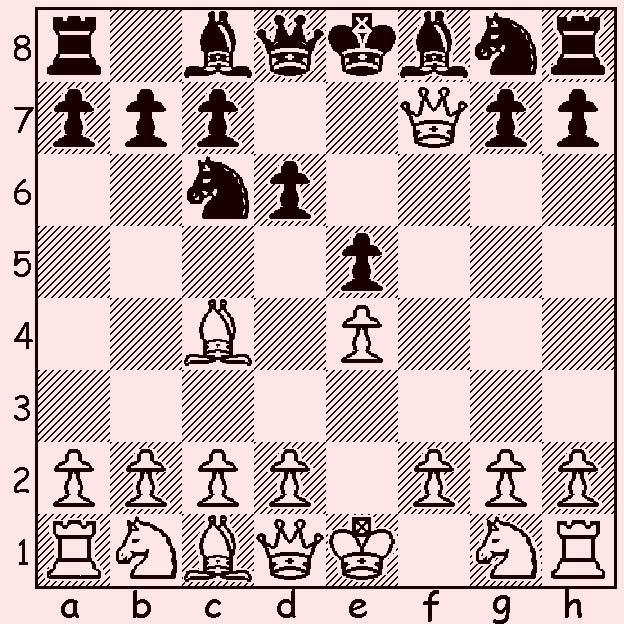
1)  e4          c5
2) Bc4        d6
3) Qf3        Nc6
4) Qxf7 #
Result: 1-0  (White wins)

This game is commonly known as the "Four-move".  There are lots of variations to this game.

Click on this sentence to open a pdf page with an even shorter chess games - win for black.
At the bottom of the page, see how you write this result as a win for Black.

Click here for a clean WP Chess notation page for you to write on.

I hope this helps.  If you go through this page before you go to the next practice (see important messages at the top) on Thursday the 3rd of May, you will definitely have an advantage!

:-)


Saturday, 28 April 2012

Chess Notation


On WP Schools Chess website, they have a link to a website that teaches chess notation.

On that website, they start with the following:

"Why is it important to know chess notation? Because it helps you read chess books and analyze your own games. And if you want to improve, it is important to know it.  Although it is relatively easy to learn the chess notation, you need to keep practicing and remember that it takes a few tries to master it. And don't give up, it will become easier! "


Please click here or on the picture below to go to that website.